
Famous Pug #004
Queen Victoria's Pugs: Royal Companions of the People's Queen
Little Pugs. Big palace. Unconditional loyalty.
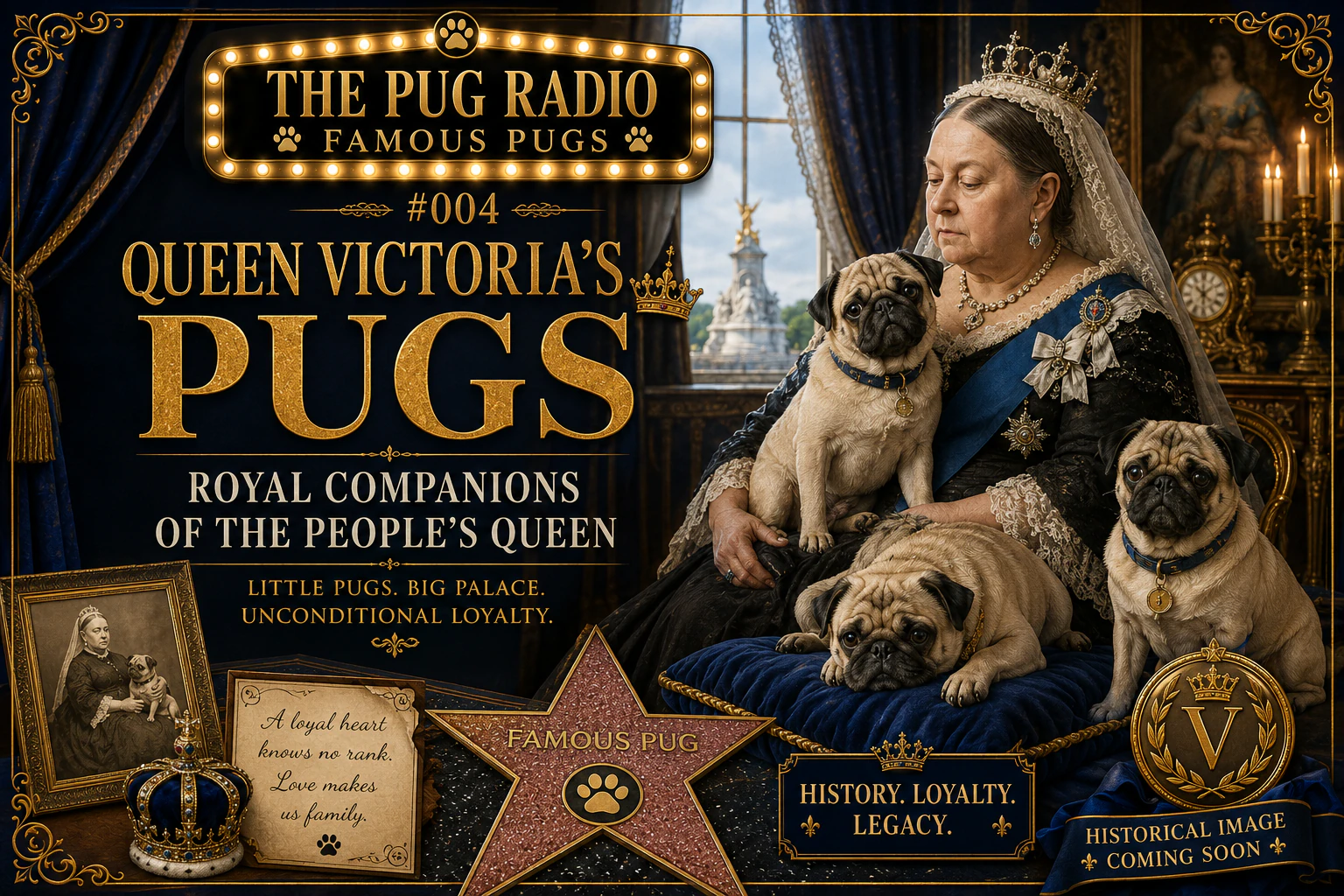 EDITORIAL ILLUSTRATION
Pugs at Windsor
Queen Victoria's love of dogs included Pugs, and the breed became part of the royal household's visual and domestic life. Her Pugs were companions first, but their names and photographs also became part of the surviving record of the Victorian court.
The royal connection should not be flattened into a claim that Victoria invented the modern Pug. It is better understood as one chapter in the breed's longer history as a favored companion in Europe.
A Kennel Full of Pugs
Royal Collection Trust accounts describe Victoria keeping many Pugs over the course of her reign - as many as 38 in the wider royal kennel record. That figure should be read as a record of the kennel across time, not as a claim that 38 dogs were all personally owned or living with her at once.
Pugs came into Victoria's life at different points. The first recorded kennel Pug may have been an unnamed dog given to her in 1845, while later dogs arrived through gifts, breeding, and connections with other royal households.
Five Names in a Photograph
A William Bambridge photograph from 1854 identifies five of Victoria's Pugs from left to right as Olga, Pedro, Venus, Minka, and Fatima. Their individual dates and acquisition notes give the group portrait an unusually personal sense of scale.
Olga lived from 21 January 1851 to 2 July 1859. Pedro, acquired in 1853, died on 8 June 1858; Venus, also acquired in 1853, died on 23 February 1860; Minka, given in 1847, died on 17 November 1859; and Fatima, from 1851, died on 21 September 1858.
From Russia to the Royal Kennels
Some of the royal Pugs had international beginnings. Royal Collection Trust records connect several dogs with Russian names to a puppy sent from Russia in July 1847, showing how royal pet-keeping could follow the same networks of gift and exchange as other court relationships.
The details are valuable precisely because they preserve individual dogs rather than only describing a general royal fondness for the breed.
Photographs of a Favorite Breed
The royal photographs make the story unusually tangible. The 1854 group portrait preserves five named Pugs, while an 1887 Balmoral photograph shows Victoria with a Pug at her feet near the end of her life.
Together, these images show Pugs not as decorative symbols floating around the court, but as recurring companions woven into the household's everyday visual record.