
Pug History #003
When Pugs Became Royal in Europe
From Dutch companion to royal favorite.
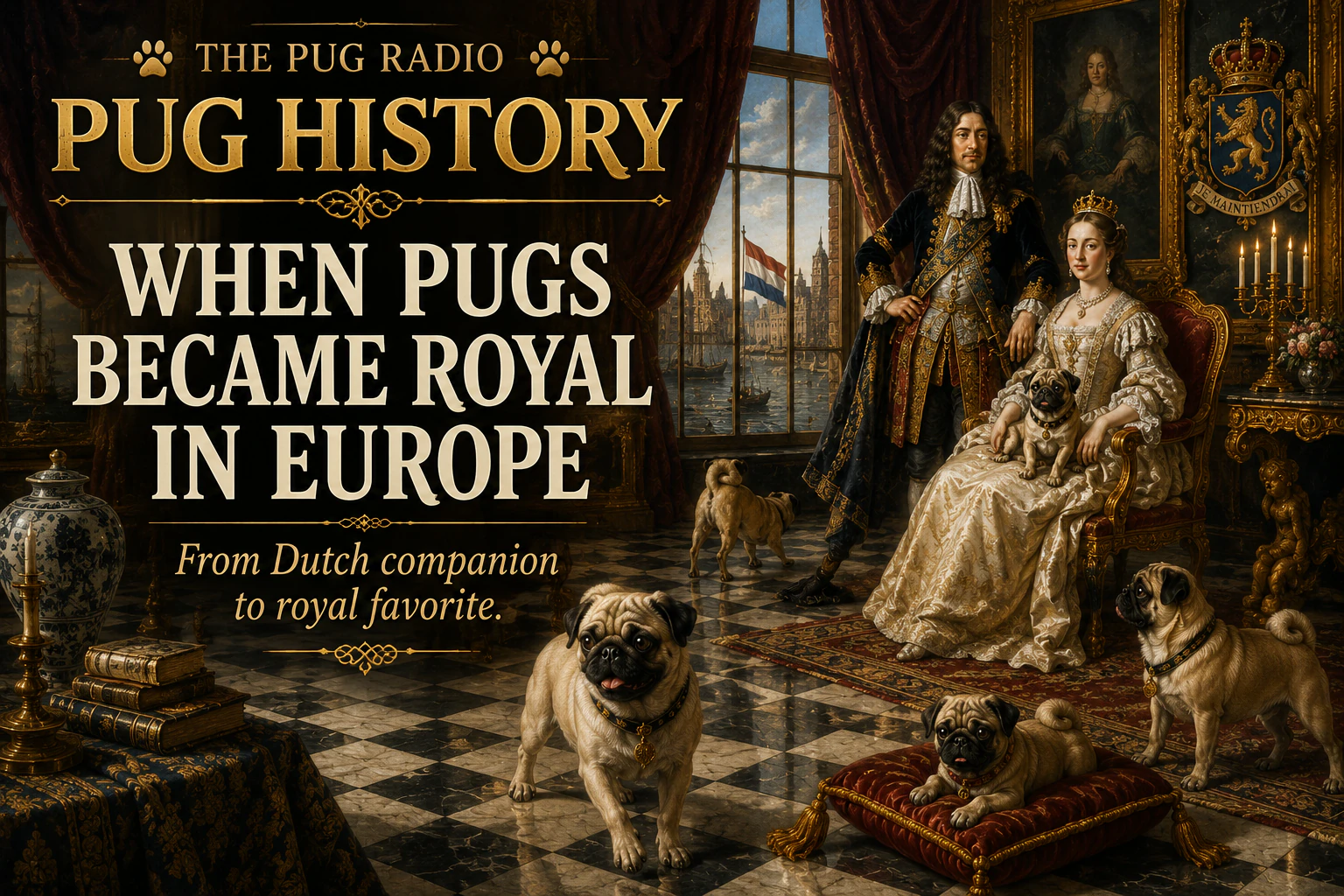
Editorial illustration by The Pug Radio
A Dutch Dog With Royal Connections
Once Pugs became established in Holland, their story became intertwined with one of Europe's important ruling dynasties: the House of Orange. The breed's role was still primarily companionship, but royal association gave the little dog much greater visibility.
This is the next step after the journey west: not a new origin story, but the moment a Dutch companion began appearing in the orbit of European power and prestige.
The House of Orange
Pugs became closely associated with the Dutch House of Orange, one of the most famous European chapters in Pug history. One of the best-known traditions credits a dog named Pompey, commonly identified in Pug histories as a Pug, with warning William the Silent of approaching danger in 1572.
That story has already been explored in Pug Fact #003. Here, its value is as evidence of how deeply Pugs became connected with Orange historical tradition, not as an indisputably documented modern breed identification.
William and Mary
William of Orange and Mary II were connected to the Netherlands before they became joint monarchs of England, Scotland, and Ireland. During the political events of 1688, William crossed to England with Mary; in 1689, they began their joint reign as King William III of England and Mary II.
The political story is larger than the Pug, but the royal household's movement mattered to the breed's history because it carried Dutch court culture into a new English setting.
Pugs Cross the Channel With Royalty
Breed histories credit William and Mary's arrival from Holland with helping establish the Pug's popularity in England. The association brought the breed into English aristocratic society and strengthened its visibility beyond the Netherlands.
The historical sources do not justify inventing an exact number of dogs, a ship, or a cinematic palace arrival. The defensible point is the broader connection: a Dutch royal household helped carry the Pug into English royal and elite culture.
A Fashionable Little Dog
Royal association could influence elite tastes. Pugs increasingly appeared as fashionable companions among aristocratic households, in portraits, paintings, wealthy homes, and royal circles.
This was not an immediate mass-market phenomenon. At this stage, the story is primarily about elite and aristocratic visibility - the kind that makes a breed recognizable long before it becomes widely familiar.
The Pug in European Art
As Pugs became established among wealthy European families, artists recorded them alongside their owners. Those paintings eventually became valuable evidence of how Pugs looked in different periods.
The portraits also remind us that historical Pugs did not always look exactly like today's breed. That changing appearance is the subject of Pug Fact #004; this chapter only needs to establish why European art became such an important record.
More Than Decoration
These dogs mattered for more than their appearance in royal portraits. Their recurring presence reinforces the Pug's remarkably consistent historical role: close human companionship.
Geography and culture changed dramatically, but the Pug repeatedly appears near people rather than as a dog developed primarily for a working task. The royal connection added visibility to a role the breed already knew well.
From Dutch Favorite to European Celebrity
The Pug began this chapter as a Dutch companion associated with the House of Orange. By the end, it had gained a foothold within English and broader European elite culture.
That foothold sets up the next stories: European paintings, changing breed appearance, Victorian Britain, organized breeding, and the standards that shaped the modern Pug.