
Pug History #006
How the Pug Became the Pug We Know Today
Two thousand years of history. One unmistakable little dog.
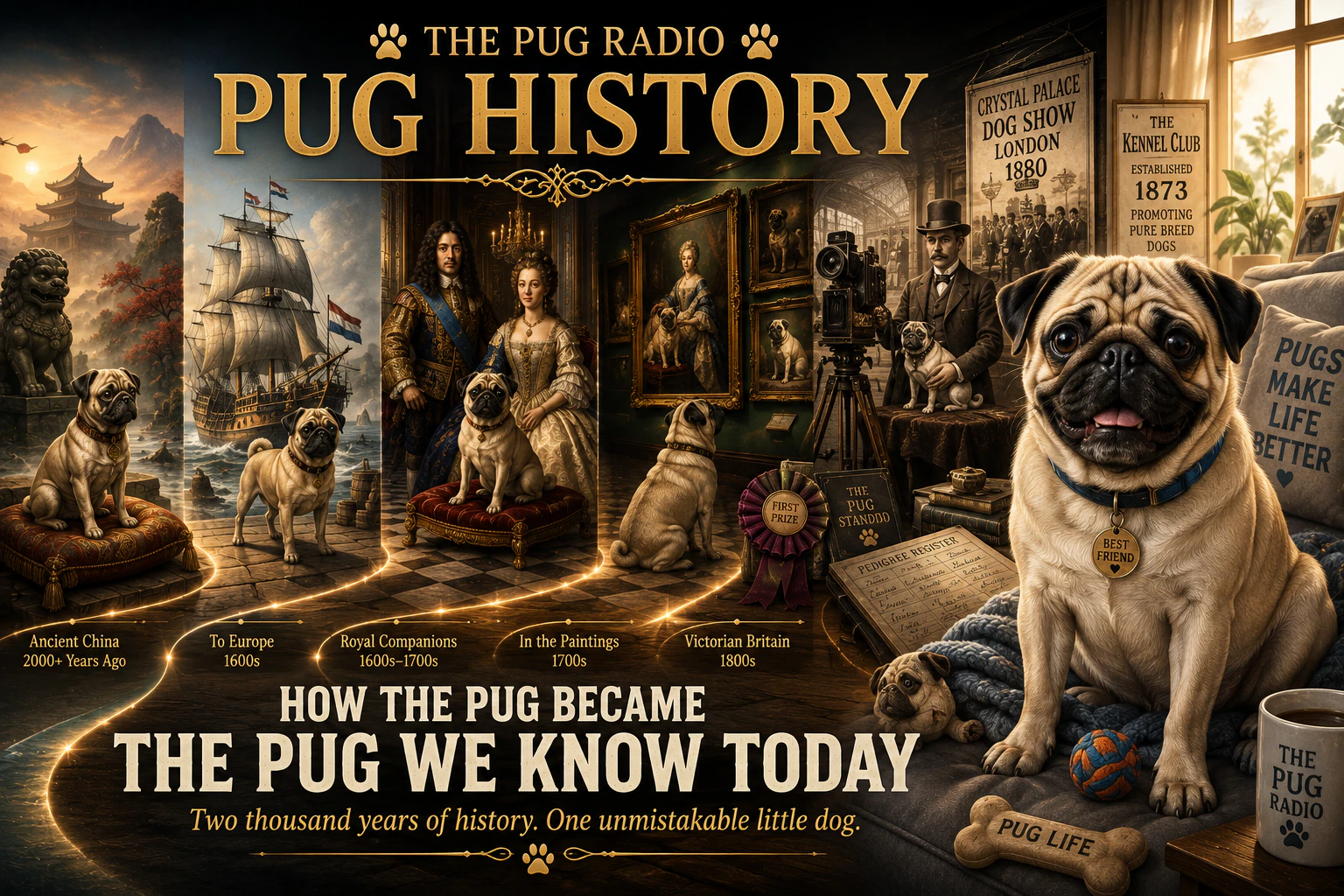
Editorial illustration by The Pug Radio
Look at a Pug Today
Look at a modern Pug and the outline seems instantly familiar: a compact body, curled tail, large expressive eyes, short muzzle, wrinkled forehead, and an enormous personality that usually prefers to stay near people.
How did this little dog get here? The answer is not one perfectly documented straight line. It is a broad historical journey through centuries of human choices, movement, fashion, recordkeeping, and companionship.
It Started With Companionship
The oldest chapter is associated with small companion dogs kept within Chinese elite and imperial culture. The story begins not with hunting, guarding, herding, or pulling, but with dogs valued primarily for being close to people.
That ancient foundation is explored in From Imperial China to the Modern Pug. Here it serves as the first thread in a longer story whose earliest centuries cannot be reconstructed as a complete modern pedigree.
The Journey West
Breed histories connect Dutch merchants and trade routes with the movement of Pugs from Asia toward Holland. The exact first voyage is not fully documented, so the responsible version follows the larger movement rather than inventing a ship, merchant, passenger dog, or precise first-arrival date.
The important development is that the Pug moved into Europe and established an important new home in the Netherlands, a transition covered in How the Pug Reached Europe.
Royal Connections Change the Pug's World
The Pug's association with the Dutch House of Orange and the later importance of William and Mary increased the breed's visibility in European society. Royal and aristocratic connections did not create the Pug, but they helped make the companion dog part of a much wider public story.
When Pugs Became Royal in Europe follows that progression without treating every royal anecdote as equally certain.
Artists Preserve the Evidence
European paintings give us surviving visual clues about historical Pugs. They also reveal that the Pug did not always look exactly like today's standardized breed: some historical dogs identified as Pugs appear leggier, less compact, or differently proportioned.
Artists were not cameras. Paintings provide evidence, not exact anatomical measurements, and Pugs in the Paintings of Europe explores what that visual record can and cannot tell us.
Victorian Britain Changes the Rules
The nineteenth century brought increasingly organized dog shows, pedigrees, registration, kennel organizations, photography, written standards, and deliberate selection toward shared breed ideals.
Victorian Britain did not invent the Pug. It helped formalize and standardize an already ancient dog type, transforming a fluid historical tradition into a breed documented through increasingly structured institutions.
The Modern Pug Emerges
Over generations, increasingly formal breeding practices produced a more consistent and recognizable breed. Modern Pug descriptions commonly emphasize compact square proportions, a tightly curled tail, a characteristic head, forehead wrinkles, large eyes, a short smooth coat, recognized color patterns, and an outgoing companion temperament.
These are modern breed characteristics, not a claim that the exact conformation existed unchanged in ancient China. Standards and breeding preferences changed over time, and the modern Pug emerged gradually rather than in a single generation.
From Palaces to Couches
The Pug's surroundings changed dramatically: imperial courts, Dutch merchants, European palaces, aristocratic portraits, and Victorian dog shows gave way to couches, car rides, family photographs, movies, social media, and modern dog communities.
The contrast is fun, but the continuity is more important. In each setting, the Pug's central role remained close human companionship.
The Job That Barely Changed
The Pug changed with history. Its favorite job barely changed at all. Geography changed, appearance changed, cultures changed, breeding became formalized, and technology changed how the dog was documented.
Yet the relationship with people remained central. The broad historical journey is well established even though the earliest centuries cannot be reconstructed as a complete modern pedigree.
History Is Still Happening
The modern Pug is another chapter, not the end of history. Breeding decisions, veterinary knowledge, welfare priorities, breed-club standards, cultural attitudes, and changing expectations about canine health and companionship continue to shape what comes next.
This is a historical observation rather than veterinary advice. The future of the breed will be written by the choices people make around the dogs who live with them.