
Pug History #005
When the Pug Became a Breed
Victorian Britain helped shape the modern Pug.
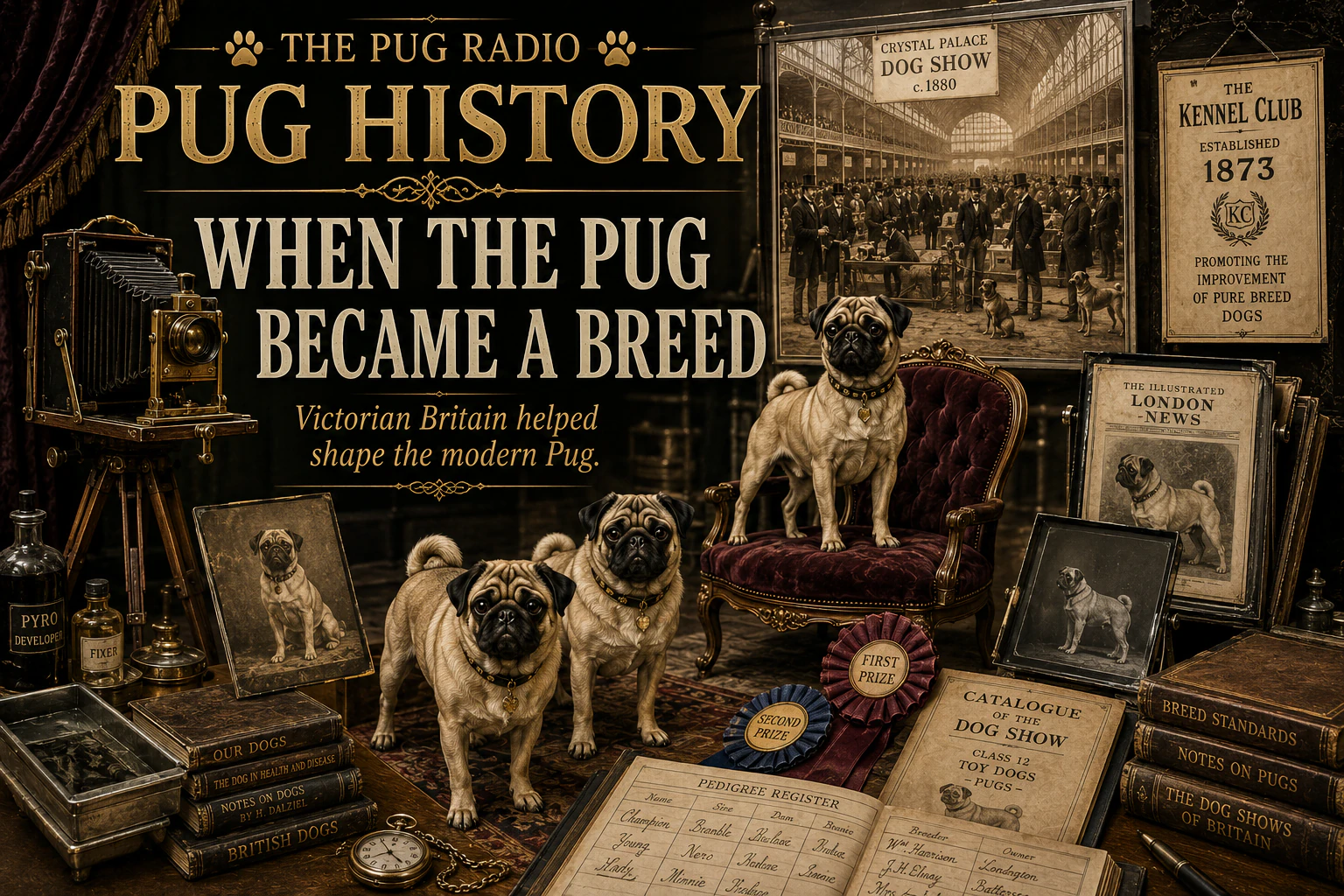
Editorial illustration by The Pug Radio
A Very Old Dog Enters a New Age
The Pug was already ancient. It had lived in China, traveled west, become associated with Dutch royalty, and appeared in European paintings. So how could the Pug 'become a breed' in Victorian Britain?
The title is editorial, not literal. During the nineteenth century, organized dog breeding, competitive shows, pedigree recordkeeping, kennel organizations, and written standards began transforming an older Pug type into the increasingly standardized modern breed.
Britain Falls in Love With Dog Shows
Nineteenth-century Britain saw the rapid growth of organized dog exhibitions. The commonly cited Newcastle show of 1859 belongs to this wider early-show history, while later exhibitions made comparison and judging increasingly systematic.
As exhibitions expanded, breeders and judges needed to discuss a practical question: what exactly should a particular breed look like? The answer was not fixed all at once, and early Pug expectations should not simply be projected backward from today's standard.
From Companion to Show Dog
Once Pugs entered an organized exhibition culture, shared expectations could be discussed and selected more deliberately. Size, proportions, head, coat, markings, tail, movement, and overall type all became part of the language of judging.
That did not turn a companion into a different animal overnight. It made a fluid historical type increasingly legible within a system that compared dogs, recorded results, and rewarded particular interpretations of the breed.
The Kennel Club - 1873
The Kennel Club was founded in Britain on 4 April 1873 by Sewallis Evelyn Shirley and twelve other members. Its importance was organizational: it helped formalize the world of pedigree registration, show rules, recordkeeping, and breed descriptions.
The Kennel Club did not create the Pug. It helped formalize the system within which breeds such as the Pug became increasingly standardized.
Pedigrees Change Everything
Breeders could track ancestry privately before centralized registration, but organized records made lineage more systematic. Registered dogs, named bloodlines, show results, and breeding records gave later generations a richer way to understand how dogs were being selected.
The change was not just administrative. A breed increasingly existed inside a shared paper trail, with definitions and expectations that could be compared across kennels and generations.
Photography Changes the Historical Record
Paintings gave us valuable clues about earlier Pugs. Photography offered something different: a mechanical image of an actual dog standing in front of a camera, preserving useful evidence about proportions, head shape, legs, muzzle, ears, tail carriage, and markings.
Old photographs still need context. Posing, lenses, retouching, and unusual angles can mislead, but photography generally gives historians stronger visual evidence than an artist's interpretation when the image and provenance are understood carefully.
The Pug Begins to Change
As breeders increasingly selected dogs toward shared ideals, the Pug's appearance became progressively more standardized. Some nineteenth-century Pugs look leggier, somewhat longer in muzzle, less compact, or less exaggerated in head shape than many modern examples.
This was not a sudden Victorian redesign. Breed development happened over generations, through changing preferences, selection, and the growing infrastructure of organized dog culture.
Black Pugs and Changing Fashion
Black Pugs also became more visible in nineteenth-century Britain, adding another thread to the period's changing fashion and breeding culture. Specific stories about imported dogs or named bloodlines should be treated cautiously unless an authoritative record supports them.
The larger point is that Victorian dog culture did not only preserve an old companion type; it also created new ideas about which colors, proportions, and characteristics belonged in the public picture of the breed.
Queen Victoria's Pugs
Queen Victoria's well-documented enthusiasm for Pugs helped keep the breed culturally prominent while formal dog breeding was developing. Her dogs belong to the royal-companion story explored in Famous Pugs: Queen Victoria's Pugs, while this chapter focuses on the institutions shaping the breed around them.
From Type to Standard
For centuries, people recognized Pugs without requiring today's formal definitions. Victorian dog culture increasingly asked what characteristics define a Pug, which dogs should be bred, which traits judges should reward, how pedigrees should be recorded, and what an ideal Pug should look like.
Those questions helped create the foundation of the standardized modern breed. The Victorians did not invent the Pug. They helped formalize it.
Sources / Further Reading
- The Royal Kennel Club: 150 Years of The Royal Kennel Club
- The Royal Kennel Club: Timeline of the 1800s
- American Kennel Club: The History of Conformation Dog Shows
- American Kennel Club: Pug History: From Emperors' Companions to Family Pets
- Pug Dog Club of America
- Royal Collection Trust: Pug Dogs, 1854 (RCIN 2082418)