
Pug History #004
Pugs in the Paintings of Europe
Centuries before photography, artists preserved the Pug.
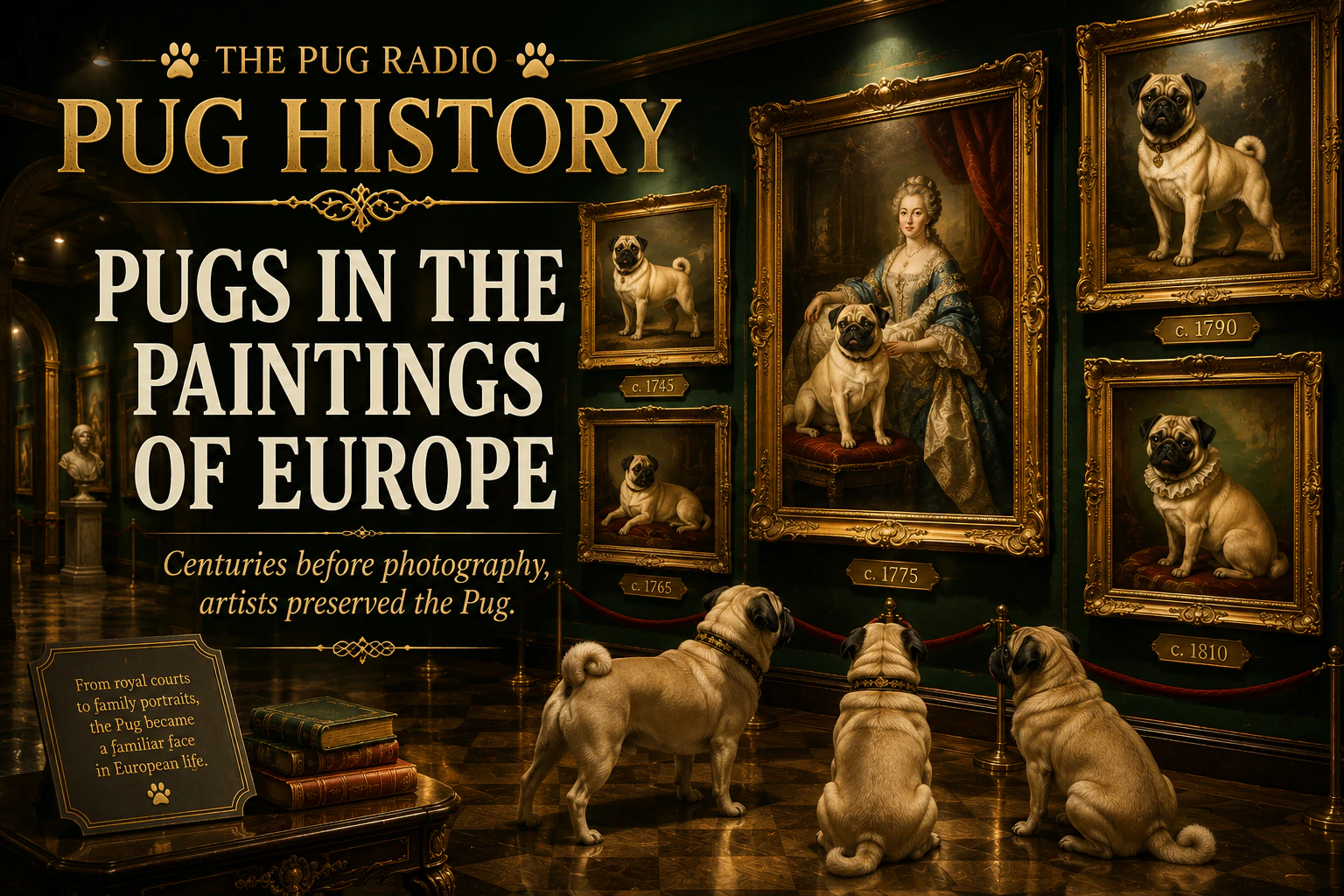
Editorial illustration by The Pug Radio
Before Cameras, There Were Paintings
Today, a dog can be documented in millions of photographs. For most of Pug history, photography did not exist, so one of the most useful surviving resources for seeing earlier companion dogs is art.
European paintings preserve images of dogs living alongside the people who owned them centuries ago. They give us a visual record, though never a perfectly complete one.
The Pug Enters the European Portrait
As Pugs became established among European royal, aristocratic, and wealthy households, they increasingly appeared in portraits. A dog beside a sitter was not necessarily random decoration: it could suggest companionship, affection, status, domestic life, or loyalty.
Those meanings should be read carefully. A painting can tell us that a dog mattered enough to be included without assigning one fixed symbol to every Pug in every work.
Pietro Longhi's Lady With a Pug
The Metropolitan Museum of Art's record for Pietro Longhi's Portrait of a Lady with a Pug, dated around 1740, is a useful example because the Pug is explicitly part of the identified subject.
The museum record anchors the title, artist, date, and catalog description. We do not need to turn the painting into a scientific measurement: its value is that it documents a Pug as a recognizable European companion in an art-historical setting.
When the Dog Is the Subject
The Met also holds Domenico Ceruti's Pug Dog, a work in which the dog itself is the subject rather than a small detail beside a human sitter. That shift in emphasis is revealing: the Pug had become interesting enough to deserve the center of the composition.
Both works are authentic museum records. The supplied Pug Radio artwork is separate modern editorial illustration inspired by this broader history, not a reproduction of either painting.
A Different-Looking Pug
Across historical artwork, some dogs identified as Pugs show proportions that differ noticeably from the modern breed: they may look leggier, less compact, or have somewhat different head and muzzle proportions.
That does not mean every historical Pug looked that way. Artists interpreted their subjects, and the breed's appearance continued changing as breeding practices and later formal standards developed.
Art Is Evidence - But Not a Photograph
Paintings are valuable historical records, but they are still paintings. An artist could idealize, exaggerate, simplify, or alter proportions according to the conventions of the period.
The responsible approach is to compare multiple works with documentary and museum sources. A painting offers a clue about the past, not a perfect anatomical blueprint for every Pug alive in its decade.
The Pug Becomes Recognizable
Repeated appearances in European artwork show something larger. The Pug was no longer simply an exotic dog arriving from the East; it had become a recognizable European companion embedded in domestic culture.
Its presence beside aristocrats, wealthy families, and other sitters demonstrates how deeply the breed had entered European life.
A Visual Record Across Generations
One painting tells us very little by itself. Works from different decades and centuries, considered together, let us watch the breed's public image and appearance change over time.
That visual record leads naturally to the next chapters: nineteenth-century Pugs, Victorian Britain, early photography, dog shows, kennel clubs, and formal breed standards.